
The project you see below is a fictitious speculative residential building. The client intends to build this residential building as an investment to rent it out – and make a profit. We intent to make a profit by building this building for him.
Keep in mind, this project is 100% fictitious. The intent is to show an example of how construction estimating can be done. No other project is ever the same, and therefore not everything can be applied to every project the same. We will keep things simple for easier understanding.
Furthermore, we will assume that only limited information (such as project documentation, reports, etc.) is available to us. This will require us to “develop” the project stepwise. In our case we have been provided with a conceptual project layout by the client (see below). The expectancy is to develop a cost budget based on given project layout. With respect to this being a real-life budget creating scenario – yes, this could be one. Indeed, often all you get is just a simple sketch with the expectancy to come up with a cost number at any given time.
THE PROJECT LAYOUT
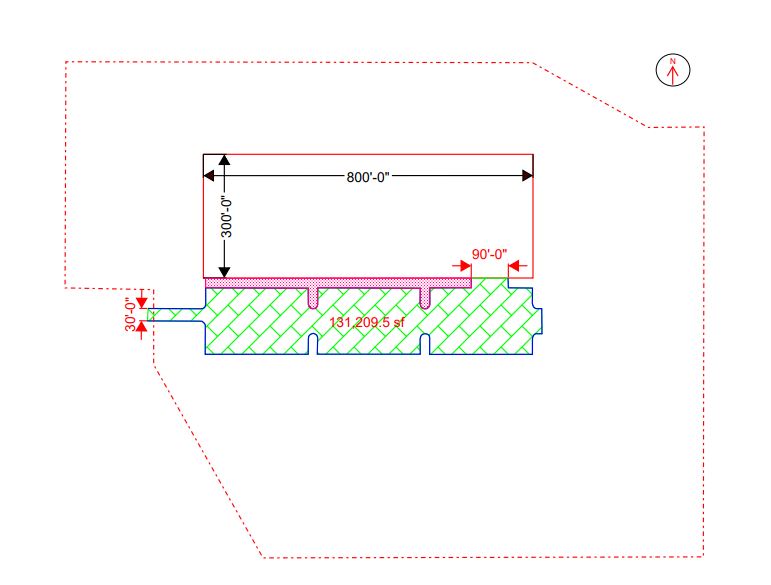
Our fictitious residential building has a building footprint of 300 LF x 800 LF (240,000 SF). The parking area will be exclusively for cars – a conventional light duty asphalt pavement is sufficient for this type of usage. The client has clarified that the building will be comprised of four residential levels, and a basement level for additional car parking, and storage. A large patio, xxx LF x xxx LF (TBD), will be in the center of the building. This patio is considered as an interior to the building.
UNDERSTAND THE PROJECT
Your first task is to understand the project and read through all available project documentation. Equally important, you also have to identify all incomplete and missing documentation.
GENERATE INFORMATION
We intent to generate as much information as possible out of the available documentation. A takeoff can do exactly that. This is the process of quantifying the material quantities required for a construction project by counting and measuring (relevant) items (objects) from a set of sketches and / or drawings.

Our most common units are linear feet (LF) and square feet (SQ). Convert those SF values right away into square yards (SY) to safe yourself some time upfront. To get square yards (SY) divide Square Feet (SF) by value (9) nine.
There are a substantial number of tools available to generate proper takeoffs. We will come to speak on how to perform proper takeoffs later.
Keep in mind that our project layout only shows a handful of construction items, while a substantially larger number of construction items (equally important) are not shown. We will use our experience and knowledge to calculate and deduce the missing construction items, required to develop a budget.
Tip: With regards to takeoffs, you can round up your numbers to make your calculations easier. Furthermore, it reads better to clients and others as well. As an example, I do round up large SF values to the nearest 50, or 100.
CALCULATING HOUSING AND BUILDING METRICS
Calculating housing and building metrics is an essential task which should be performed simultaneously, or right after finishing your takeoffs. You will make your life a lot easier by having those metrics at hand from the get-go. Specific housing and building metrics are needed to help calculate required material quantities.
Tip: We can benefit from the fact that our building has a rectangular shaped footprint. You can program an excel spreadsheet to calculate your building metrics automatically, rather than calculating all by hand. However, if your building does have an unclear geometrical shape (neither round, rectangular, triangular, etc.), then a larger effort is needed to determine required building metrics.
— MORE IN DEVELOPMENT —
CONCLUDING
Takeoffs and calculation of housing and building metrics is a necessary step to calculate required material quantities. Notice that we are calculating building metrics from the outside to the inside, like peeling of an orange one layer at a time. For unknown information, we use our knowledge and experience in residential construction to choose typical values or make realistic assumptions to fill in the blanks – so we can keep on calculating needed metrics, on which further metrics are based on. With a good number of housing and building metrics now at hand, we can proceed with calculating material quantities.
 Estimating-Mindset