
This can be one of the most complicated tasks based on the information that has been provided to you!
In essence you are looking for meaningful pricing from your Subcontractors, Material Suppliers, Vendors, etc. that you will incorporate into your own proposal as part of a complete package you are offering. As always garbage IN is garbage OUT. Providing incomplete and faulty information in an untimely manner evidently will lead to incomplete proposals with high contingencies for incorrect work scopes. Proper sharing of information is key!
The client is interested in meaningful numbers from your side. In many cases he will accordingly forward you required information and documents in an organized fashion, but do not expect this! More often than not, the information you receive is incomplete and unorganized. In these circumstances, you and your team will have to generate the required information yourself to make sure your bidders can price you properly.
This is what I learned from my superior and mentor: Learning how to digest provided information and to convey it in a condensed and clear manner. To take time to craft a proper message. Forwarding of poor information is of no help to anyone and evidently a reflection on oneself as well. In essence, do whatever is needed so that your bidder understands what he is supposed to price. If this means to create a set full of sketches – do it! If this means to click pictures and share those – do it! If this means to write up and generate entire Scope of Work – do it!
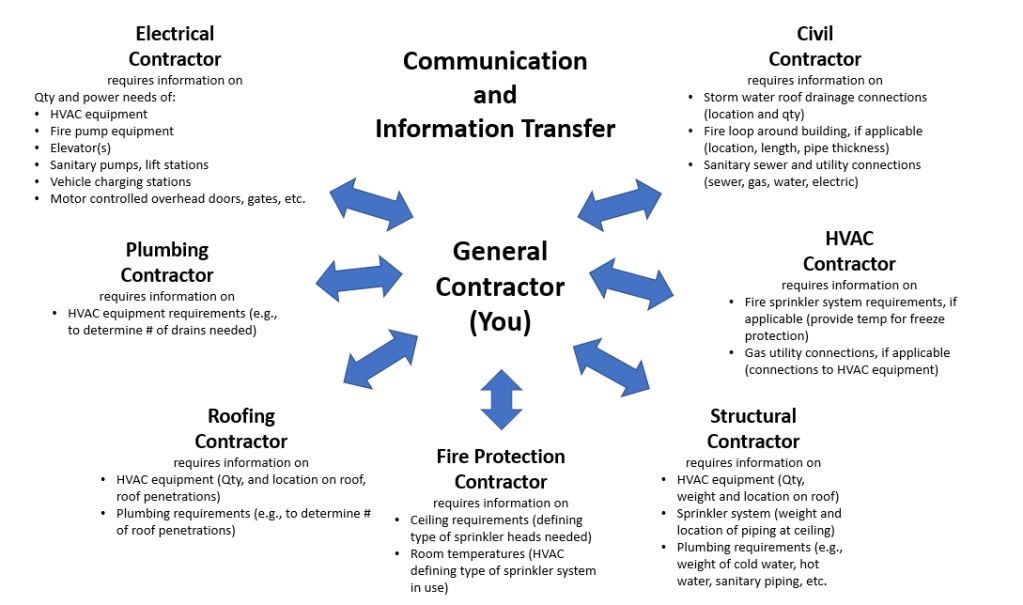
Let’s add another layer to this: Communication and information transfer is two-sided between you and any bidder, and you are connected to each bidder individually. Hence communication and information transfer is multi-sided, with you as the general contractor at its core. This means that transfer speed and accuracy is largely influenced by you.
Once the subcontractor has received and studied the essential project information (Scope of Work, Schedule, Terms and Conditions, etc.) he in turn will provide you his comments, recommendations, and field requirements he needs fulfilled to successfully execute the proposed. Some of these requirements can be fulfilled by you, while others can only be fulfilled by other subcontracted trades. They need to know these requirements, too.
Let’s clarify this through an example: No information is available on HVAC equipment. The HVAC contractor has selected the equipment he needs to furnish and install to fulfill the client’s specific need for air ventilation. The HVAC equipment is to be installed on the roof. The structural engineer of your steel contractor needs to know weights, dimensions, and locations of the equipment to account for it properly in his design. The roofing contractor needs to know quantity, dimensions, and locations of the equipment for all roof related flashing, sealing work, etc. The plumbing contractor needs to know qty, and locations of the equipment to account for right amount of condensate piping. This example shows how trades can be interconnected with each other. You must share with all of them the right information!
The graphic below is just an example of communication and information transfer during a bidding process in a very early project stage (e.g., conceptual or budgetary) with limited available information, and preliminary drawings, where your potential subcontractors partially support you in developing the required Scope of Work. It is by no means a complete depiction, but merely shows a couple of recurring highlights for a few randomly selected trades. Furthermore, it does not depict communication and information transfer with your client, designers and / or exterior entities whose input is equally as important. Just to mention a few items: Zoning and development plan, governing building code, geotechnical report, reports on available utilities (water and gas pressure tests), etc.
 Estimating-Mindset